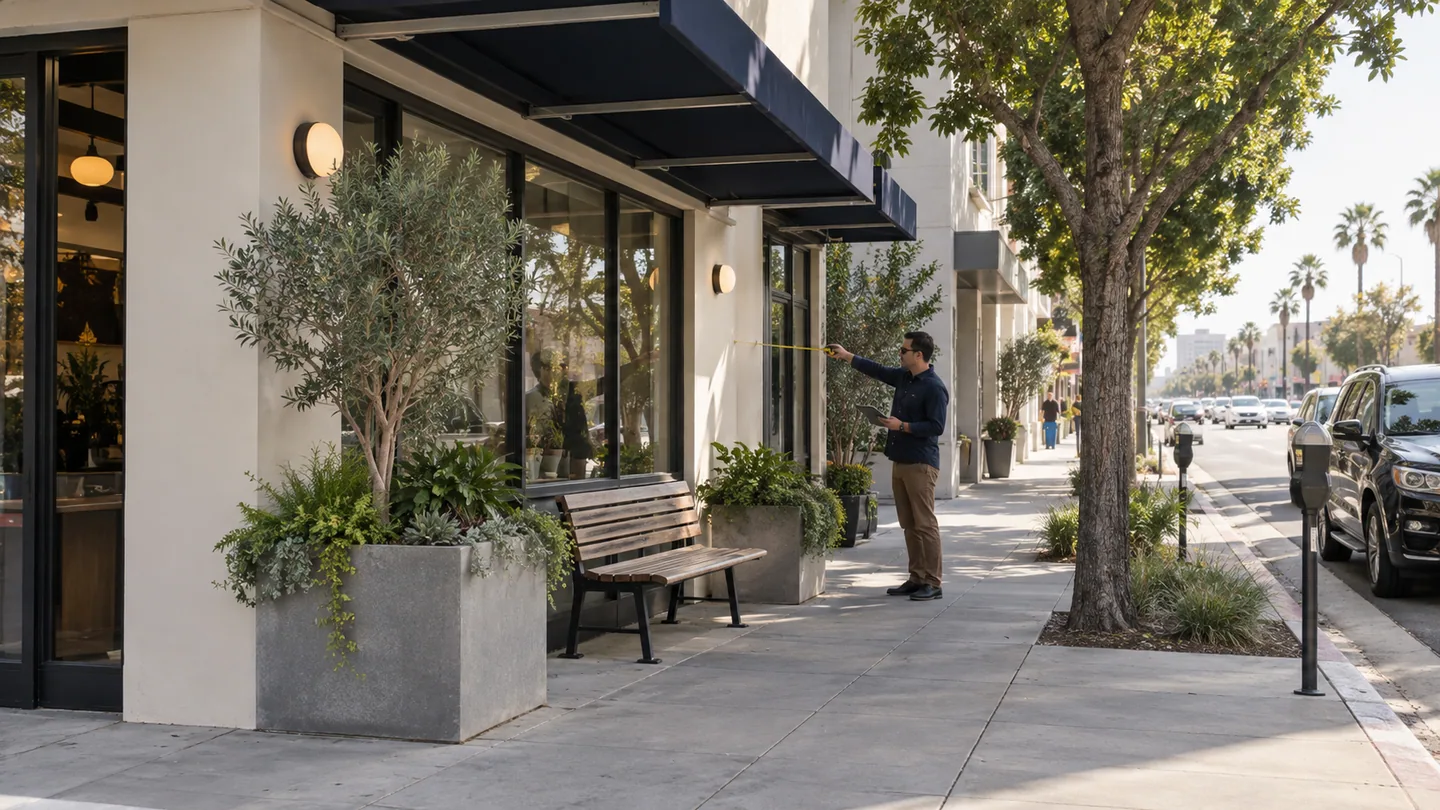
The useful question is not only whether work is near a street. It is whether a private feature will occupy, project into, cross, or otherwise affect property that is part of the public right-of-way—and how the City classifies that proposal.
Not every project involving the public right-of-way uses the same permit pathway. The applicable City requirements depend on the scope and circumstances of the project.
Start with the encroachment, not the permit name
An R-Permit is intended for certain private encroachments. The first task is therefore to identify the exact item, its ownership and use, its dimensions, and its location relative to the property line, sidewalk, curb, street, parkway, alley, or easement.
A repair to a standard sidewalk and a private planter placed within the sidewalk area both involve public space, but they do not necessarily follow the same permit path. Likewise, authorization to maintain an encroachment does not automatically authorize its construction.
Examples of projects that may involve an R-Permit
The current BOE overview lists many examples of projects for which an applicant may seek a Revocable Permit. These include:
- Fences and gates that meet applicable zoning requirements
- Planters, tree grates, non-standard tree wells, and selected landscape or irrigation systems
- Special sidewalk pavers or art incorporated into a sidewalk
- Awnings, canopies, architectural features, steps, signs, and marquees
- Handrails, emergency exit doors, and selected street furniture
- Commercial or electrical conduits, vaults, and access hatches
- Driveway bridges, certain retaining walls, pedestrian bridges, and portions of private structures
- Sidewalk dining tables and chairs
This is not an exhaustive eligibility list. Some categories have separate technical procedures, and a listed example may still be denied or require a different or additional permit.
Sidewalk-related situations
Sidewalk areas must continue to support public travel, access, street trees, utilities, loading, visibility, and other public functions. Typical encroachments identified in BOE’s sidewalk procedure include railings, fences, walls, bollards, signs, planters, private structures, non-conforming bicycle racks, stairways, and ramps.
City review may consider the pedestrian access route, curb clearance, loading zones, entrances, driveways, street furniture, utilities, sight distance, materials, maintenance, and the relationship to existing infrastructure. Sidewalk dining has its own current technical guidance and should not be treated as a generic furniture installation.
Structures, projections, and hardship circumstances
Private structures generally are not intended to occupy public right-of-way. The R-Permit process can nevertheless provide a mechanism to evaluate certain private structures or building projections. Official guidance also recognizes special circumstances where topography or constraints within private property could create a hardship.
Examples can include awnings, canopies, architectural features, steps, mechanical equipment, portions of a building, pedestrian walkways, driveway bridges, and similar improvements. Structural projects can require engineered plans, calculations, a B-Permit, building review, or other approvals in addition to the R-Permit.
Why surrounding conditions matter
Consistency with nearby encroachments can influence the review. A proposal that differs significantly from neighborhood conditions may raise additional questions or involve outreach to the Council Office, Neighborhood Council, or homeowners association. That context is one reason site photographs and a clear frontage plan are useful.
Relationship with A-, B-, and excavation permits
An R-Permit concerns the revocable encroachment. Construction in the public right-of-way can require a separate A-Permit, B-Permit, or Excavation Permit. A project may therefore need more than one City approval.
For an introduction to the permit’s meaning, read what a Los Angeles R-Permit is. For more examples, see common R-Permit project situations.
Common questions
Does every private item in a parkway require an R-Permit?
Not necessarily. Exemptions, standard treatments, zoning, and project-specific rules may apply. Confirm the current City pathway for the actual proposal.
Can an existing encroachment need review?
Yes. Existing private improvements in the right-of-way can raise permit, compliance, ownership, or enforcement questions.
Is an R-Permit the only approval needed?
Often it is not. Construction, excavation, planning, building, structural, or other approvals may also apply.
Official Source
R-Permits.com is an independent informational and permit-support website. Examples do not establish eligibility or approval. Requirements, fees, conditions, and permit classification are determined by the applicable City departments.
Related articles
Have a Los Angeles project involving the public right-of-way?
Review available R-Permit preparation services or share the proposed encroachment and location.
Discuss Your R-Permit Project View All Resources